Last updated 2026-08-18
TL;DR
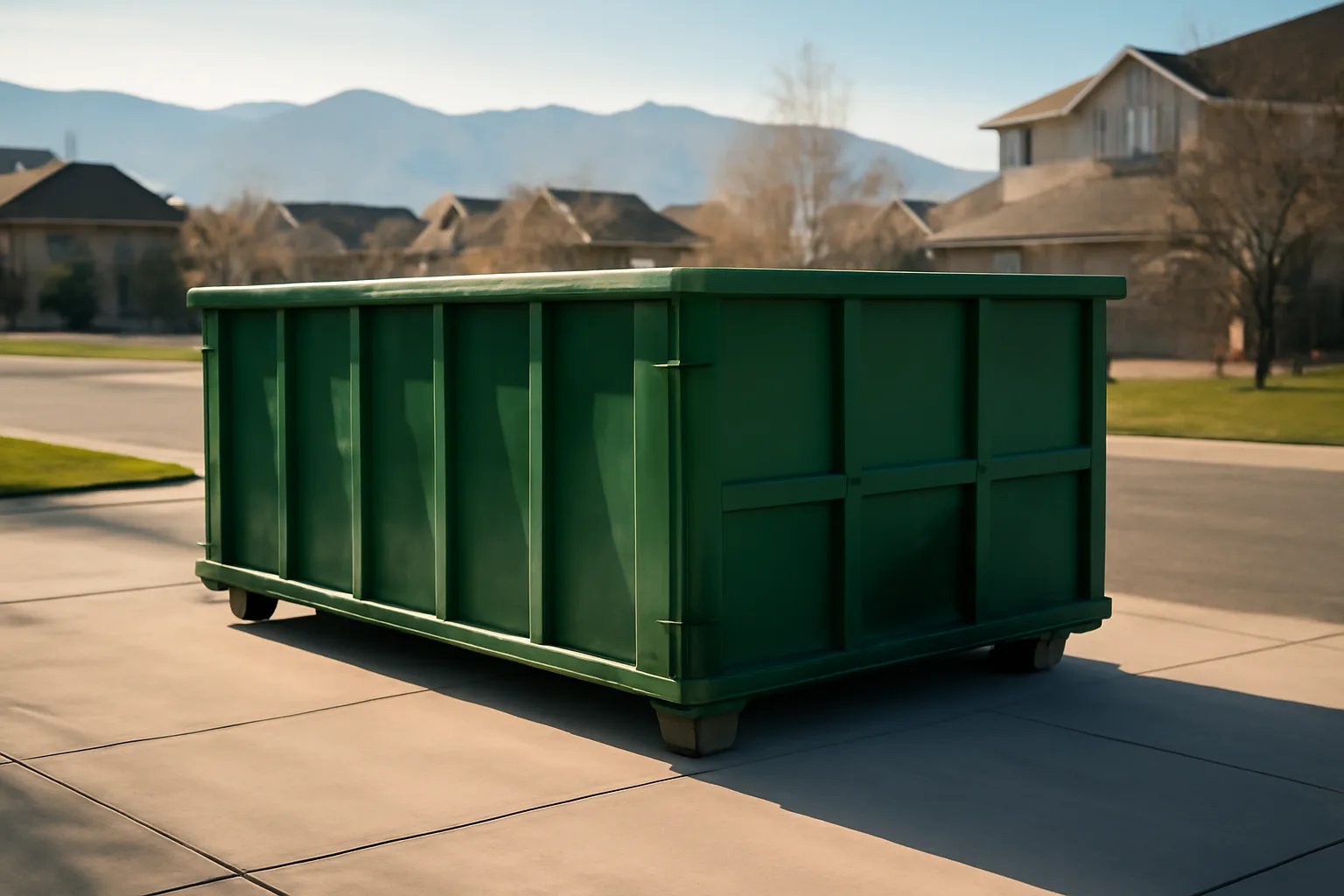
A roll-off dumpster rental in Colorado typically costs $250 to $800 or more depending on container size, haul distance, disposal fees, and landfill tipping rates. Metro Denver rentals cluster around $350, $550 for a 10 to 20 yard bin. Mountain and rural counties cost more. No statewide residential hauler license is required, though some counties and cities add local permits.
How much does a roll-off dumpster cost in Colorado?
Most Colorado roll-off rentals land between $250 and $800 for a standard 7 to 14 day period. That range hides a lot. A 10-yard bin in suburban Denver might run $275, $350. A 30-yard container hauled to a mountain job site in Summit County can clear $700 before a single overage charge hits.
Three things control the final number more than anything else: container size, the landfill tipping fee at your nearest transfer station, and how far the driver has to go. Tipping fees vary by facility across Colorado. The Front Range Landfill operated by Waste Connections near Watkins is a major disposal destination for metro Denver haulers, and the gate rate there moves with waste type. The Colorado Department of Public Health and Environment (CDPHE) tracks solid waste facilities statewide [1].
Fuel surcharges are real here, and they are not trivial. I-70 mountain corridors mean longer haul times and higher fuel costs for any company running bins to Breckenridge, Aspen, or Glenwood Springs. Expect a 15 to 25 percent premium over the Denver metro baseline for mountain deliveries.
Overage fees are where customers get surprised. Most companies price a dumpster to include one ton of material. Going over means a per-ton charge on top of the flat rate, often $50, $85 per additional ton. Concrete, dirt, and roofing shingles hit weight limits fast. Ask the hauler for their weight allowance and overage rate before you book. That one number decides more of your final invoice than the sticker price does.
What are typical roll-off dumpster prices by size in Colorado?
Container sizes are measured in cubic yards. The four most commonly rented sizes in Colorado are 10, 15 or 20, 30, and 40 yards. Prices below are ballpark ranges for the Denver metro area, built from publicly available quotes from Colorado-based haulers. Mountain and rural areas run higher.
| Container size | Typical Denver metro range | Weight allowance (common) |
|---|---|---|
| 10 yard | $250, $375 | 1 to 2 tons |
| 15 yard | $300, $425 | 2 tons |
| 20 yard | $350, $525 | 2 to 3 tons |
| 30 yard | $425, $650 | 3 to 4 tons |
| 40 yard | $550, $800+ | 4 to 5 tons |
These are rental-only ranges. They assume standard debris (mixed construction waste, household junk). Heavy materials like concrete or asphalt almost always trigger a different pricing tier or require a dedicated heavy-debris dumpster.
A 10-yard bin fits roughly three pickup-truck loads of debris. A 20-yard bin is the most popular size for residential remodels and roofing jobs. A 40-yard bin is usually reserved for large commercial demolition or new construction.
Want a real comparison point? Roll-off dumpster cost in Arizona shows similar climate and distance dynamics but without Colorado's elevation surcharge.
What drives roll-off dumpster prices up in Colorado specifically?
Colorado has a few cost factors that stay quiet in flat-terrain states.
Elevation and mountain access is the biggest one. Haulers serving ski towns deal with longer round trips, steep grades that burn fuel and wear out trucks, and seasonal road restrictions. A company running dumpsters from Denver to Telluride (roughly 330 miles each way) absorbs a very different cost structure than one serving suburban Aurora.
Landfill scarcity matters in some regions too. Colorado has 23 active municipal solid waste landfills permitted by CDPHE [1]. Some rural counties sit far from any permitted facility, which adds haul cost and ultimately shows up in your quote.
Colorado's environmental rules around certain waste streams add compliance costs. Asbestos-containing materials require special handling under CDPHE regulations that track the federal National Emission Standards for Hazardous Air Pollutants (NESHAP) rules [2]. If your project involves pre-1980 materials, expect either a separate abatement contractor or a much higher disposal fee.
Wildfire debris deserves a mention. Colorado has had major burn events across multiple counties. Some haulers run dedicated post-fire cleanup pricing that differs from standard residential rates, partly because mixed ash and debris needs specific disposal protocols.
Denver's urban core has permit requirements for dumpsters placed in the public right-of-way. Denver issues right-of-way use permits through its transportation department [3]. The fee is modest, but the process takes time, and most haulers charge a pass-through fee for handling it.
Do you need a license for roll-off dumpster service in Colorado?
This is where a lot of people starting a roll-off business in Colorado get tripped up. There is no single statewide hauler license from one agency that covers everything. Licensing here is layered.
At the state level, Colorado does not have a separate roll-off hauler registration the way some states do. What you do need is a commercial driver's license (CDL) if your truck's gross vehicle weight rating (GVWR) exceeds 26,001 pounds, which almost any roll-off truck will [4]. CDLs are issued through the Colorado Department of Revenue, Division of Motor Vehicles [7].
For operating a waste hauling business, the main state touchpoint is CDPHE's solid waste program. Own and operate a disposal facility, and you need a CDPHE permit. Run a pure transport and delivery company, and you're not operating a disposal site, so that specific permit doesn't apply to you directly. You still have to dispose at a CDPHE-permitted facility [1].
Local rules vary a lot. Denver requires a business license and a trash hauler license to haul commercial solid waste within city limits, administered through Denver's transportation department [10]. Boulder County has its own requirements. Jefferson County, El Paso County, and others each run their own business licensing processes.
Starting a roll-off company and trying to get the paperwork straight? The RollOffPath independent kit at /start covers the document checklist for operators working through multi-layer state and local licensing.
Interstate hauling or any federal motor carrier activity means FMCSA registration and a USDOT number [5]. Colorado follows federal motor carrier rules for commercial trucks crossing state lines.
So you won't find a single "roll-off dumpster license" form in Colorado. You're assembling a package: CDL, business registration through the Secretary of State [8], FMCSA/USDOT number if applicable, and whatever the specific city or county requires. Confirm the exact local requirements with the jurisdiction before you start.
How long does a roll-off dumpster rental take in Colorado?
Most Colorado haulers offer next-day or two-day delivery for standard sizes in metro areas. Same-day delivery exists, but you'll usually pay a premium for it and it hinges on inventory.
Rental periods are almost always 7 to 14 days for a flat-rate rental. After that, daily or weekly overage fees apply, typically $5, $15 per day for extended rental. Ask this explicitly before you book. The variation between companies is wide.
Pickup after you call for haul-out runs from same-day to 3 business days depending on the company's route schedule. Mountain-area customers should budget a longer lead time, since fewer haulers serve those routes and scheduling is tighter.
If your dumpster sits in the public right-of-way in Denver, the permit process adds time. Denver right-of-way permits can take 2 to 5 business days for standard applications [3]. Don't schedule delivery before the permit is approved.
For a business just starting up, the timeline is also about how long it takes to get licensed and operational. CDL testing wait times at Colorado DMV vary by location and examiner availability [7]. FMCSA USDOT number registration is online and generally processes within a few days for new applications [5]. Local business license timelines swing from same-week for simple online processes to several weeks in jurisdictions with manual review.
How do Colorado landfill tipping fees affect your rental price?
Tipping fees are what the disposal facility charges the hauler per ton to accept waste. The hauler passes that cost to you, baked into the flat rental price up to your included weight allowance, then billed as a per-ton overage beyond that.
Colorado's tipping fees vary by facility and waste type. General municipal solid waste at a Front Range transfer station or landfill runs in a range that haulers translate to $50, $85 per ton in overage charges. CDPHE publishes the list of permitted solid waste facilities but not real-time gate rates, which private operators set [1].
CDPHE's solid waste reporting puts Colorado's total generation at roughly 14 million tons in 2021 [6]. That volume creates steady demand at permitted facilities and keeps pricing relatively stable, though specific gate rates at individual sites can change without notice.
If you're disposing of roofing shingles, the asphalt content sometimes means separate pricing or a surcharge. Concrete and brick often get handled as a "clean fill" or "inert debris" stream at lower tipping fees, which is why some haulers offer a separate concrete dumpster at a lower all-in price. Colorado's solid waste regulations under 6 CCR 1007-2 govern how these facilities and waste streams are permitted [9].
The practical takeaway is simple. Ask any Colorado hauler what their included weight allowance is and what they charge per ton over it. On a heavy project, that single number matters more than almost anything else in the quote.
Are there permit requirements for placing a dumpster in Colorado?
On private property, generally no permit is required. Your driveway, your job site on private land, no government paperwork in most cases.
In the public right-of-way, the answer flips. Denver requires a right-of-way use permit for any obstruction in the public right-of-way, dumpsters included [3]. Boulder, Fort Collins, Colorado Springs, and other cities run their own versions of this requirement. Most of the larger municipalities do.
Unincorporated county areas tend to have fewer requirements, but don't assume. Some Colorado counties have road use agreements or setback rules that could affect placement near roadways.
Homeowner associations are separate from government permits and very much real. Some Colorado HOAs have rules about dumpster placement, appearance, or duration. That's not a legal licensing issue, but it's a practical one that stalls residential jobs.
If your placement could block a fire lane or hit public safety, expect the fire district or public works department to get involved. Colorado takes fire access seriously across its high wildfire-risk counties.
How does Colorado roll-off pricing compare to neighboring states?
Colorado sits in the mid-to-upper range compared to its neighbors, mostly because of the geographic factors above.
Arizona generally has lower tipping fees in the Phoenix metro and flatter terrain, which pulls base prices down on average. Roll-off dumpster cost in Arizona covers that market in detail.
Florida's pricing takes shape differently, driven by population density and hauler competition rather than geography. Roll-off dumpster cost in Florida reflects that.
California has some of the highest tipping fees in the country because of strict disposal rules, which puts it well above Colorado for most waste categories. Roll-off dumpster cost in California shows how that lands in quotes.
Idaho and other Mountain West states have their own dynamics. Lower population density means fewer haulers and less price competition in rural areas. Roll-off dumpster cost in Idaho is useful context if you're comparing the region.
Within Colorado, the gap between Denver metro pricing and mountain or rural pricing is big enough that you really can't treat the state as one market for budgeting.
What should you ask a Colorado hauler before booking?
Most of the surprises on a final roll-off invoice come from questions the customer never asked. Have the conversation before you book.
Start with the weight allowance. Every quote has one. Know what it is.
Ask about prohibited materials. Most Colorado haulers won't accept tires, batteries, paint, liquids, hazardous waste, or appliances containing refrigerants (freon). Some won't take electronics. Putting prohibited materials in a roll-off can trigger extra disposal fees or a refused pickup.
Ask about the rental period and the daily overage rate. A 14-day rental you actually need for 21 days costs real money if you didn't plan for it.
Ask if they handle permits. If your dumpster goes in a Denver or Boulder right-of-way, ask explicitly whether the hauler pulls the permit and what they charge, versus you handling it yourself.
Ask about delivery access. Colorado properties vary enormously. Some mountain driveways simply can't take a standard roll-off truck. A few haulers run smaller trucks for tight access; many don't. Find this out before delivery day, not during it.
Starting a hauling business instead of renting for a project? The RollOffPath /start kit organizes the document and licensing research into a structured checklist that covers Colorado's layered requirements.
What's the cheapest way to rent a roll-off dumpster in Colorado?
The honest answer is that cutting corners on a dumpster rental rarely saves as much as people expect. But there are real ways to keep costs down.
Book the right size the first time. Renting a second bin because you underestimated volume costs far more than sizing up at the start.
Avoid heavy materials if you can. Roofing tear-off, concrete pour removal, any project with dense debris: ask haulers specifically about heavy-debris pricing versus a standard rental. Sometimes a specialty bin or a separate haul beats overage fees on a standard bin.
Keep to the rental period. Daily overages add up fast. If you think you need 14 days, book 14 days upfront rather than extending.
Compare at least three local quotes. Colorado has a healthy number of independent haulers alongside the national companies (Republic Services, Waste Management, Waste Connections). Independents often have lower overhead and more flexible pricing. The trade-off is sometimes tighter scheduling.
Time it right. Demand climbs in spring and summer construction season. Booking in late fall or winter sometimes gets you a better rate, though Colorado weather creates its own complications for outdoor work.
For how other markets handle these dynamics, roll-off dumpster cost in Illinois covers a high-competition urban market where independent haulers pushed prices down hard.
Frequently asked questions
Do you need a license to run a roll-off dumpster business in Colorado?
There's no single statewide roll-off hauler license in Colorado. You'll need a CDL if your truck exceeds 26,001 pounds GVWR, a USDOT number and FMCSA registration for commercial motor carrier activity, a state business registration, and whatever local licenses the city or county where you operate requires. Denver, for example, has a separate trash hauler licensing process for commercial solid waste collection. Confirm exact requirements with each relevant jurisdiction.
How much does a 10-yard dumpster cost in Colorado?
A 10-yard roll-off dumpster in the Denver metro area typically runs $250 to $375 for a standard 7 to 14 day rental, including roughly 1 to 2 tons of weight allowance. Mountain or rural areas cost more due to longer haul distances and higher fuel costs. Overage fees for weight above the included allowance commonly run $50 to $85 per additional ton.
How much does a 20-yard dumpster cost in Colorado?
A 20-yard dumpster in the Denver metro area typically runs $350 to $525. This is the most popular size for residential remodels and roofing jobs. Mountain and rural Colorado locations add a premium for distance and elevation. The 20-yard bin usually includes 2 to 3 tons. Go over with heavy debris like shingles and you'll see overage charges quickly.
How long can you keep a roll-off dumpster in Colorado?
Standard rental periods run 7 to 14 days for a flat rate, depending on the hauler. After that, daily overage fees apply, typically $5 to $15 per day. Some companies offer weekly extended rentals at a fixed additional charge. Ask before you book. Pickup after you call for haul-out takes 1 to 3 business days in metro areas and potentially longer in mountain or rural counties.
Do you need a permit to put a dumpster in your driveway in Colorado?
On private property, including your own driveway, no permit is generally required in Colorado. If the dumpster goes in the public right-of-way, you need a permit from the relevant city or county. Denver issues right-of-way use permits for street-placed dumpsters. Check with your HOA separately, as some Colorado HOAs have their own rules about dumpster placement and duration.
Why is a roll-off dumpster more expensive in mountain Colorado?
Mountain and rural Colorado haulers deal with much longer round-trip distances, steep grades that increase fuel costs and truck wear, and seasonal road conditions. There are also fewer permitted disposal facilities in some regions, which adds haul distance to the nearest accepting facility. Expect to pay 15 to 30 percent more in mountain areas compared to Denver metro baseline pricing for the same container size.
What materials can you not put in a Colorado roll-off dumpster?
Most Colorado haulers prohibit tires, batteries, paint, liquid waste, hazardous chemicals, asbestos-containing materials, electronics, and appliances containing refrigerants. Asbestos materials require separate abatement and disposal under CDPHE regulations that track federal NESHAP rules. Prohibited materials can result in extra disposal fees or a refused pickup. Always confirm the prohibited list with your specific hauler before loading.
How much does a dumpster permit cost in Denver?
Denver issues right-of-way use permits for dumpsters placed in the public right-of-way. Permit fees are set by the city and can change. Most haulers who handle the permit pass the fee through to the customer, sometimes with a small administrative markup. The permit application process typically takes 2 to 5 business days for standard applications. Confirm current fees directly with the city before budgeting.
What is the cheapest roll-off dumpster size in Colorado?
The 10-yard bin carries the lowest base price, running roughly $250 to $375 in Denver metro. But cheap-per-quote and cheap-per-project are different. If you underestimate volume and need a second bin, total cost exceeds what a 20-yard bin would have cost upfront. For most residential remodel or cleanout projects, a 20-yard bin is the better value even though the quoted price is higher.
Do Colorado haulers charge by weight or by the bin?
Colorado haulers typically charge a flat rental fee that includes a specific weight allowance, commonly 1 to 3 tons depending on size. Above that allowance, they charge per additional ton, often $50 to $85 per ton. You're billed for both the bin and the weight. Heavy debris projects like concrete demo or roofing tear-offs frequently trigger weight overages that add significantly to the final invoice.
How long does it take to get a CDL in Colorado for hauling dumpsters?
The timeline varies by testing location and examiner availability. You'll need to study for and pass the CDL knowledge tests, then schedule and pass a skills test with an examiner. The Colorado DMV administers CDL testing. Budget several weeks from starting the process to getting your license in hand, accounting for study time, test scheduling, and any wait lists at your local testing location. Confirm current wait times with the Colorado DMV.
Are roll-off dumpster prices negotiable in Colorado?
Yes, especially with independent haulers who have more pricing flexibility than large national companies. Volume discounts for contractors booking multiple bins are common. Booking in the off-season (late fall, winter) sometimes yields better rates. The most effective negotiating tool is having competing quotes. Get at least three quotes for any rental and ask each hauler directly if they can match or beat a competitor's offer.
What is the difference between a transfer station and a landfill in Colorado?
A transfer station is a facility where waste is consolidated from collection vehicles and reloaded onto larger trucks for transport to a landfill. Most roll-off haulers in Colorado use transfer stations rather than hauling directly to a landfill. CDPHE permits both types of facilities. For customers, the practical difference is mostly invisible, but tipping fees at transfer stations and landfills can differ, which affects your overage charge rate.
Sources
- Colorado CDPHE, Solid Waste Facility Search: Colorado has permitted solid waste facilities statewide; CDPHE is the regulatory authority for solid waste disposal sites
- EPA, Asbestos NESHAP (40 CFR Part 61 Subpart M): Asbestos-containing materials require special handling under federal NESHAP rules, which Colorado tracks
- City and County of Denver, Right-of-Way Permits: Denver requires a right-of-way use permit for dumpsters placed in the public right-of-way; processing typically takes 2-5 business days
- FMCSA, Commercial Driver's License Requirements (49 CFR Part 383): A CDL is required for vehicles with a GVWR exceeding 26,001 pounds, which applies to most roll-off trucks
- FMCSA, Register Your Business (USDOT Number): FMCSA USDOT number registration is required for commercial motor carriers; online applications generally process within a few days
- Colorado CDPHE, Solid Waste Program: Colorado generated roughly 14 million tons of solid waste in 2021 according to CDPHE's reporting
- Colorado Department of Revenue, Division of Motor Vehicles, CDL Information: CDLs in Colorado are issued through the Colorado Department of Revenue, Division of Motor Vehicles
- Colorado Secretary of State, Businesses: Colorado business registration is administered through the Secretary of State's office
- CDPHE, Solid Waste Regulations, 6 CCR 1007-2: Colorado's solid waste regulations under 6 CCR 1007-2 govern permitted disposal facilities and waste transport requirements
- City and County of Denver, Department of Transportation and Infrastructure: Denver requires a separate trash hauler license for commercial solid waste collection within city limits